Yesterday I have written about the Legend of Sigurd/Siegfried on my Instagram and I will use this space to expand on the thoughts. This article is inspired by the book I am currently reading ”The Occult Truths of Myths and Legends” (Collected Works of Rudolf Steiner). I thought it would be an interesting topic to present.
Sigurd/Siegfried, the Dragon Slayer.
Power, Fate, and the Limits of Self-Knowledge
The legend of Sigurd endures not because it is a story of triumph, but because it refuses to resolve the tension between power and limitation.
At first glance, it appears to follow the familiar structure of the heroic narrative: a young man of exceptional ability confronts a monstrous force, overcomes it, and acquires both treasure and knowledge. He becomes, in many respects, more than human, nearly invulnerable/divine, endowed with heightened perception, and elevated above ordinary men.
And yet, the story does not culminate in sovereignty or lasting victory. It ends in betrayal and death.
This is not incidental. It is the point.
In the older Germanic and Norse sources, particularly the Völsunga saga, the narrative does not present itself as a moral lesson in the modern sense. It does not instruct the listener on how to avoid tragedy, nor does it suggest that greater strength or greater knowledge might alter the outcome.
Instead, it presents a world governed by a deeper structure, often described as wyrd or fate, in which even the most exceptional individual remains embedded.
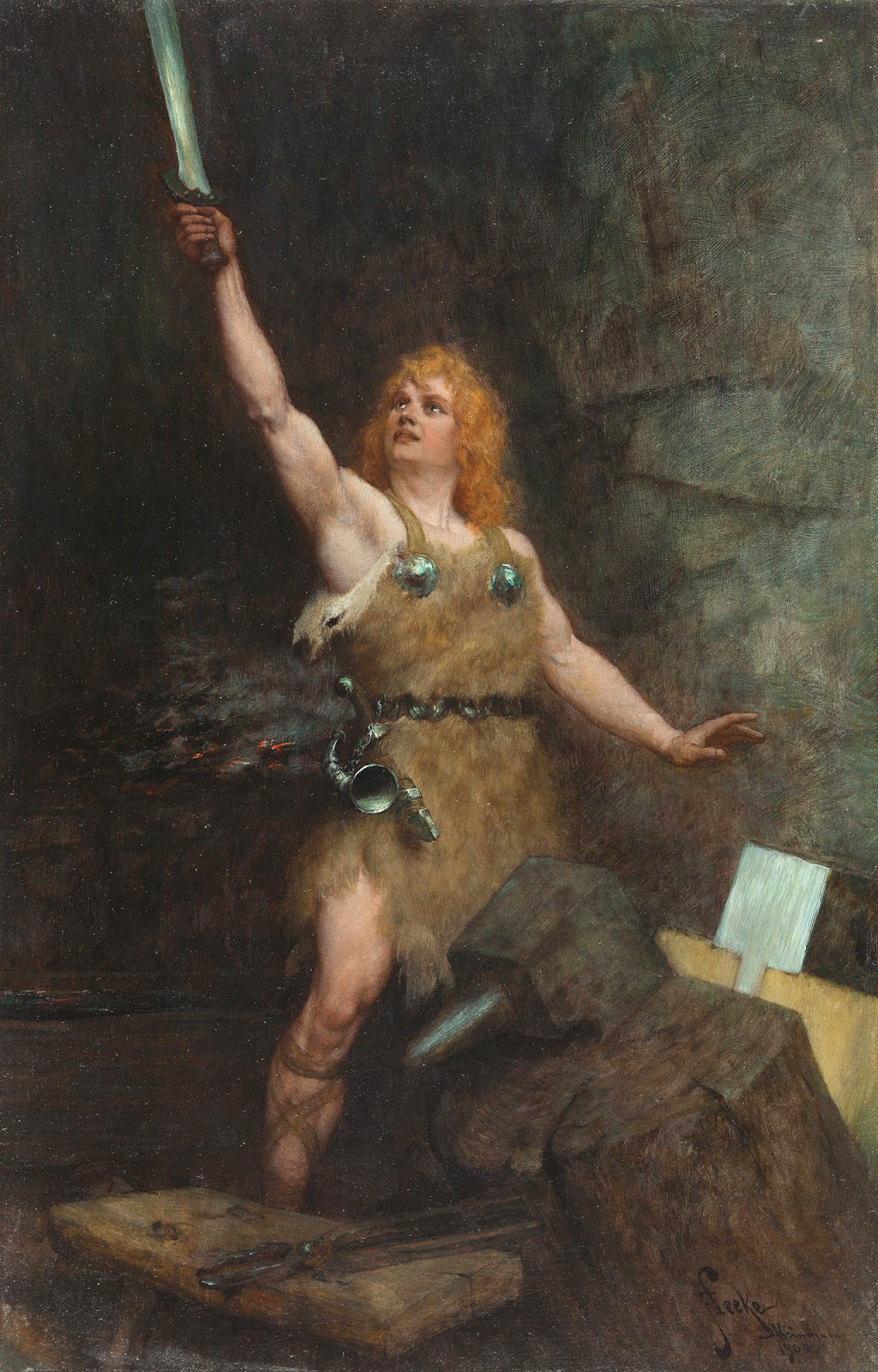
Sigurd slays the dragon Fafnir, who guards a vast and cursed treasure. By killing the dragon and bathing in its blood, he becomes nearly invulnerable. He gains access to hidden knowledge, symbolised by his ability to understand the speech of birds.
From a modern perspective, these elements appear to signal transcendence. The hero has overcome the beast, integrated its power, and ascended beyond ordinary human limitation.
But the myth does not confirm this interpretation. It undermines it.
Despite his transformation, Sigurd remains subject to forces he does not perceive. His invulnerability is incomplete. A single leaf, resting unnoticed on his back as he bathes in the dragon’s blood, prevents that small area from being protected. This detail is not merely narrative, it is structural. It introduces the central paradox of the story:
That even the most powerful individual contains within himself an unknown point of vulnerability.
The Nature of the Dragon and the Treasure
The dragon Fafnir is not simply an external adversary. Even within the original myth, he is already a transformed being, a creature shaped by greed, isolation, and the corruption of the treasure he guards.
The hoard itself is not neutral wealth. It carries a curse. Those who come into contact with it are drawn into cycles of betrayal, violence, and destruction. Power, in this context, is not stabilising. It is destabilising. It binds rather than liberates.
This is a crucial distinction from many later narratives of heroism. The acquisition of power does not resolve tension; it intensifies it.
The hero does not emerge from the encounter purified and secure. He emerges entangled.
Knowledge? An issue?
One of the more subtle aspects of the myth is the role of knowledge. After tasting the dragon’s blood, Sigurd gains the ability to understand the language of birds. This is often interpreted as a symbol of higher perception, an awakening into a deeper layer of reality.
And yet, this knowledge does not save him.
He is warned of danger. He perceives certain truths that would remain hidden to others. But this expanded awareness is partial. It does not extend to the full complexity of human motives, social structures, and deception.
In other words, the myth distinguishes between different kinds of knowing. There is knowledge of nature, of hidden forces, of instinctive truths, and there is knowledge of human beings, which operates according to a different logic.
Sigurd possesses the former, but not the latter.
The Jungian Reinterpretation
With Carl Jung, the legend is reinterpreted through the lens of depth psychology. The dragon becomes what he calls, the shadow, the repressed, unintegrated aspects of the psyche. The act of slaying the dragon represents the beginning of individuation: the process by which the individual confronts and integrates unconscious material.
Within this framework, Sigurd’s transformation is genuine. He has achieved something essential. He has confronted what lies beneath the surface.
However, Jung places particular emphasis on the detail of the leaf, the unprotected spot. This becomes a symbol of the irreducible unconscious: that portion of the psyche that remains outside awareness, even in individuals who have undertaken significant inner work.
From this perspective, Sigurd’s death is not merely fate. It is the consequence of incomplete integration. The hero has gone far, but not far enough.
This interpretation renders the myth psychologically meaningful and applicable. It transforms a tragic narrative into a model of inner development.
And yet, in doing so, it introduces a subtle shift: it implies that, with sufficient awareness, the outcome might have been different.
The original myth does not make this promise.
Steiner: The Evolution of Consciousness
Rudolf Steiner extends the interpretation further, situating the legend within a broader narrative of spiritual evolution.
For Steiner, myths are not merely symbolic expressions of the psyche, but records, albeit in imaginal form of real stages in the development of human consciousness. Sigurd represents a transition: the emergence of an individual who is no longer guided by collective instinct or divine authority, but by his own autonomous will.
This is a significant step. It marks the birth of a new kind of human being.
However, this individuality is not yet complete. It is powerful, but insufficiently reflective. It lacks full awareness of its own limitations and of the complexity of the human world.
In this reading, Sigurd’s downfall is not simply tragic. It is developmental. It belongs to a necessary phase that must be surpassed.
Here again, the story is given direction. It becomes part of a larger trajectory, an upward movement toward greater consciousness and integration.
The Unresolved Tension
When these interpretations are placed alongside the original myth, a tension becomes visible.
The Norse and Germanic sources present a world in which fate is binding, power is ambivalent, and knowledge is limited. There is no clear indication that tragedy can be avoided through inner development or spiritual progress. The story does not offer resolution. It offers recognition.
Jung and Steiner, in different ways, seek to make the myth usable. They translate it into frameworks of psychological and spiritual development. They introduce the possibility, implicit or explicit, that greater awareness might alter the outcome.
This does not invalidate their interpretations. On the contrary, it explains their enduring influence. They render the myth meaningful within a modern context.
But it is important to recognise what is gained and what is lost in this process.
The original story retains something that later interpretations soften: the possibility that there are limits which cannot be overcome, blind spots which cannot be fully illuminated, and structures within which even the most developed individual remains embedded.
The Blind Spot as a Structural Principle
The image of the leaf on Sigurd’s back is not a minor detail. It is the axis of the entire narrative.
It represents a condition rather than an accident: that self-knowledge is inherently incomplete. That there are aspects of the self which remain inaccessible, not due to lack of effort, but due to the structure of consciousness itself.
Others can see what he cannot. This asymmetry is decisive.
It is not the dragon that ultimately destroys Sigurd. It is not a lack of strength, nor a lack of courage. It is the intersection between his unseen vulnerability and the actions of others who perceive it.
This introduces a second layer to the myth: the social dimension. The world of human beings, of alliances, betrayals, resentments, and strategies that operates according to a different logic than the world of heroic confrontation.
Sigurd is adapted to one, but not the other.
The Limit of Victory
The legend of Sigurd does not deny the possibility of strength, transformation, or even greatness. It affirms all of these.
But it places a boundary around them. You may confront the dragon. You may acquire power. You may expand your perception beyond that of ordinary men.
And still, there will remain something you do not see.
Whether this is understood as fate, as the unconscious, or as a stage in a larger process depends on the framework one adopts. The myth itself does not decide. It simply insists on the existence of the limit. And in doing so, it preserves a form of knowledge that is both unsettling and enduring:
that what lies outside of awareness does not merely accompany us, it participates in shaping the outcome.
Not as an exception, but as a rule.


 JULIA'S WELLNESS TIPS
Leave a comment